
Multivitamins and minerals
Anni Dahms
Founder of the retail chain ANNI’s VITAL SHOP.
Nurse & Health Specialist, Biopath and Nutritional Adviser
You can read Anni’s Newsletter in the following languages:


Our body needs vitamins and minerals every single day. They are essential for digesting our food and converting it into energy and vitality. Without these nutrients, the body quickly falls into deficiency.
Vitamins play a central role in all the body’s cellular functions. Enzymes in the body can only function optimally when they are linked to the right vitamins. Without this connection, among other things, the immune system, energy production, bones, muscles and nervous system are affected. Without enzymes, cellular metabolism comes to a halt – and life, in principle, cannot be sustained.
The nutrition we consume and the way we metabolise it are crucial for the internal environment we create in the body. It is this environment that determines the living conditions of our cells – and therefore our health.
Unfortunately, we live in a time where a large part of our diet consists of processed foods and empty calories, while the need for vitamins and minerals remains unchanged. International studies show that ultra-processed foods often account for 40–50% of daily energy intake in Western countries.
Therefore, it is more important than ever to take responsibility for our health. If we have children, it is equally our responsibility to ensure they receive the necessary vitamins and minerals, so that we actively support the health and well-being of the family. A good multivitamin and mineral supplement can be a strong tool in a modern everyday life where the diet is not always optimal.

A practical choice in everyday life
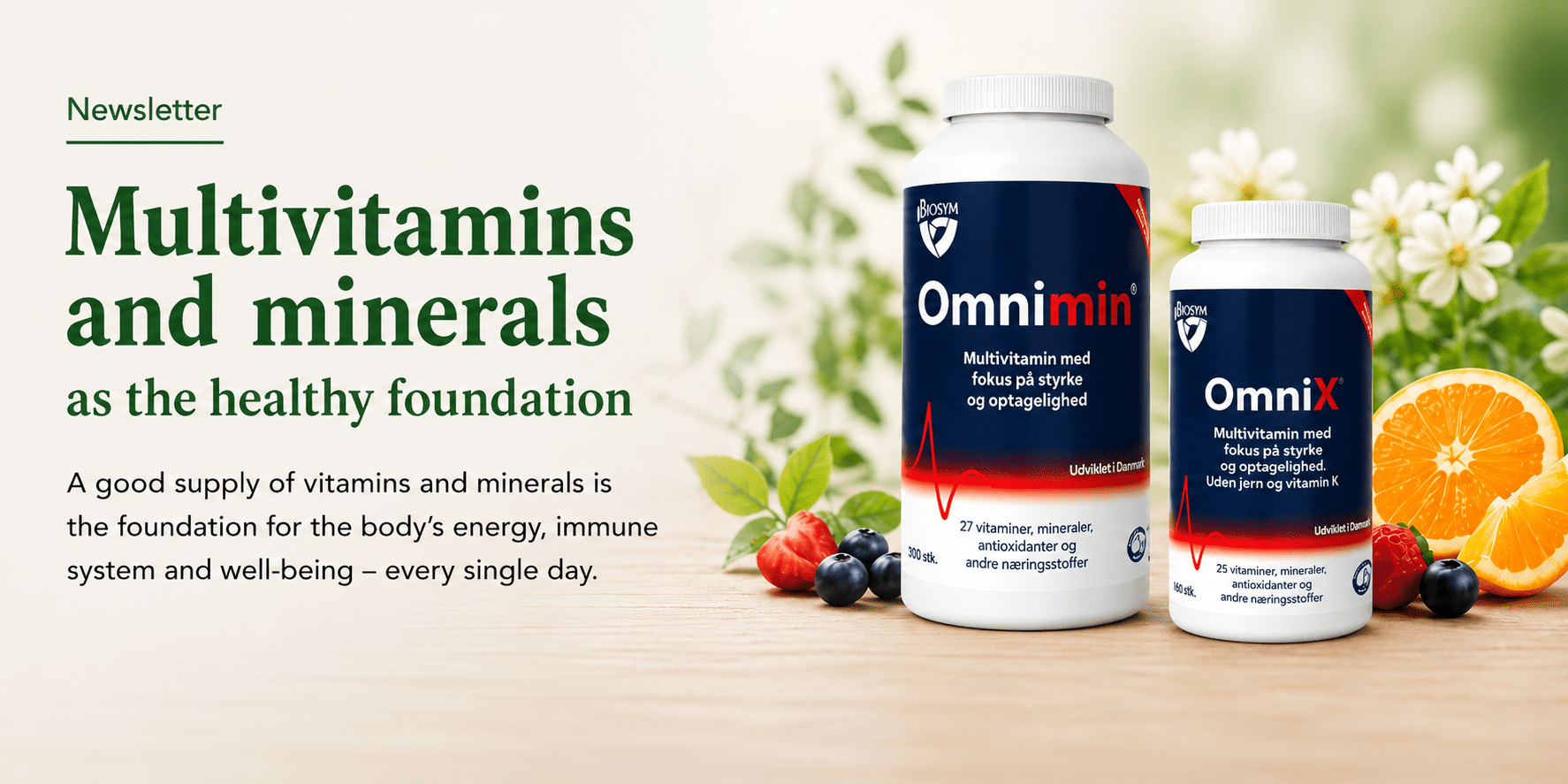
Today, there are good supplements that combine both vitamins and minerals in well-balanced doses. One example is Biosym Omnimin, which is often regarded as a well-developed and properly dosed multivitamin and mineral product.
A daily supplement can therefore be a simple and effective way to support the body – especially in an everyday life where the diet does not always meet the requirements.
Water- and fat-soluble vitamins
Vitamins are divided into water- and fat-soluble.
Water-soluble vitamins include B vitamins and vitamin C. They are not stored in the body but are excreted via urine and sweat. Therefore, a daily intake is important. They are generally difficult to overdose. The B vitamins in particular work closely together and should therefore be taken collectively, as an imbalance can lead to deficiency in other B vitamins. These vitamins are also sensitive to processing – for example, vitamin C is easily destroyed by heat.
Fat-soluble vitamins – A, D, E and K – are easy to remember. They are stored in the body and are primarily excreted through the intestines. Their importance for health is very significant, and they play an important role in the body’s functions. In order to be absorbed, they require the presence of fat in the diet.

Minerals and trace elements
Minerals and trace elements are just as essential as vitamins and should always be seen in relation to them. There is a significant synergy between these nutrients, and they are highly dependent on each other for optimal absorption and function.
The word “mineral” originates from the Latin minera, meaning ore. Minerals are natural components of the Earth’s crust. Plants absorb inorganic mineral salts from the soil and convert them into organic compounds that animals and humans can utilise. They function, among other things, as building blocks in cells and as part of the enzymes that control the body’s chemical processes.
Minerals make up approximately 4% of the body’s weight and are divided into two main groups:
- Macrominerals: (requirement above 0.1 g daily): e.g. calcium, magnesium, potassium, sodium, chloride, sulphur and phosphorus.
- Trace elements:(very small amounts): e.g. iron, zinc, selenium, manganese, chromium, silicon, iodine, fluoride, boron, lithium, gold, silver, molybdenum, germanium and vanadium.Although trace elements are only required in very small amounts, they are vital, as they act as activating components in the body’s enzymes.
The interaction is crucial
Vitamins, minerals and other nutrients work in a complex and finely balanced interaction. Research is continuously being conducted into how they influence each other – also in relation to antioxidants and fats.
Therefore, it is important to choose supplements of high quality, where the nutrients are in a form that the body can easily absorb. At the same time, it is often recommended to take nutrients together, as they support each other’s function. For example, calcium works closely with magnesium and vitamin D, which are important for the body’s utilisation of calcium.
Therefore, it is important to choose supplements of high quality, where the nutrients are in a form that the body can easily absorb. At the same time, it is often recommended to take nutrients together, as they support each other’s function.


Selenium – an important partner to Q10
Selenium is an essential trace element and an important antioxidant that the body needs in small amounts.
Research suggests that selenium and Q10 work particularly well together. The combination may help support heart function, energy levels and protect cells against oxidative stress. At the same time, both nutrients play an important role in cellular energy production.
Selenium is also part of the body’s own antioxidant enzymes, which protect cells from damage caused by free radicals. When selenium and Q10 are combined, they can therefore complement each other and strengthen the body’s natural defence.
The combination is considered particularly relevant with age, when the body’s own production of Q10 declines.


Sun allergy
It is the season when the sun is to be enjoyed. At the same time, it is important to prevent sun allergy by protecting the skin from the sun’s UVA and UVB rays – especially in spring.
It may be beneficial to strengthen the skin from within with beta-carotene supplements and to start at least 8–10 weeks before the sun’s intensity increases. Beta-carotene is stored in the subcutaneous fat and builds up gradually, which may make the skin less vulnerable to UV rays. Many people therefore experience fewer outbreaks of sun allergy as well as reduced redness and irritation.
However, supplements cannot replace sun protection. Beta-carotene is a supplement and cannot in itself protect against the sun’s rays.
Remember to gradually accustom the skin to the sun. Use sunscreen with a high SPF, preferably a fragrance-free variant for sensitive skin, seek shade between 12 and 3 pm, and be aware that certain types of medication can increase the skin’s sensitivity to light.


